87.76% of Tremella Mushroom Extract Is Hyaluronic Acid, 2025 Study Finds
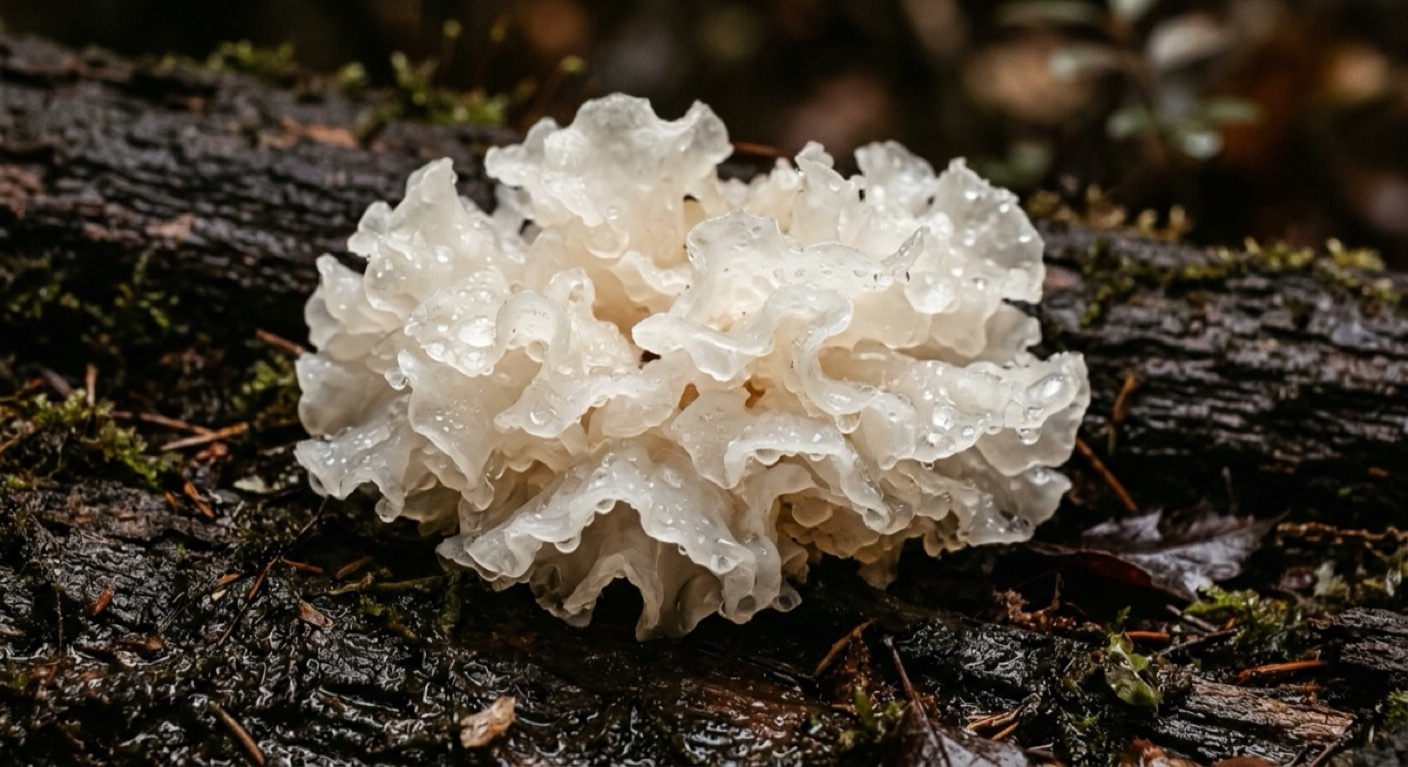
Tremella fuciformis, commonly called snow mushroom or white jelly fungus, has been used in East Asian traditional medicine for skin elasticity and hydration for centuries. What modern ingredient science had not fully established was exactly what makes it work. A study published in April 2025 in MDPI Foods changed that by chemically characterizing what Tremella extract actually contains.
87.76% Hyaluronic Acid
The study’s most significant finding was the composition of the extract itself. Total polysaccharide content reached 90.6% of the extract’s dry weight. Of those polysaccharides, hyaluronic acid was by far the dominant component at approximately 87.76%.
This matters because previous research had attributed Tremella’s moisturizing properties to “tremella polysaccharides” (TPS) that act similarly to hyaluronic acid. This 2025 study confirms that the hydrating effect is not just analogous to HA. A large fraction of the extract is HA. The mechanism is not metaphorical. It is direct.
Molecular Weight: 5,185 kDa
Particle size analysis measured the number-average molecular weight (Mn) at 5,185 kDa. Hyaluronic acid above 2,000 kDa is classified as high-molecular-weight (HMW) HA. Tremella-derived HA exceeds this threshold by more than double.
HMW HA works primarily at the surface of the skin. Rather than penetrating into deeper dermal layers, it forms a film over the stratum corneum that slows water evaporation. Tremella-extracted HA falls squarely into this surface hydration and moisture-locking category.
Quality Validation: pH, Purity, Heavy Metals
The study went beyond confirming HA presence to verifying cosmetic ingredient quality standards comprehensively.
pH was 6.5, within the skin-appropriate range of 5.5–7.5. Uronic acid content was 2.39%, confirming structural integrity of the HA polymer. N-acetylglucosamine (NAG) residue was below 0.1%, a signal of high polymer stability. Heavy metal screening showed most metals below detectable limits. Sodium content measured at 1.77%, confirming this is hyaluronic acid rather than sodium hyaluronate salt, an important distinction for formulation and purity assessment.
Water content at 7.6% supports long-term stability and bioactive preservation.
A Vegan Hyaluronic Acid Alternative
The two primary commercial sources of hyaluronic acid are animal-derived (rooster comb, other connective tissue) and microbial fermentation (Streptococcus equi bacterial strain). Animal-derived HA is incompatible with vegan formulations; bacterial fermentation sources are also questioned by some consumers.
Tremella offers a plant-based option. Extraction from the mushroom sporocarp requires no animal inputs and no fermentation organisms. As demand for certified vegan skincare grows, this sourcing distinction is increasingly a product differentiation point. The 2025 study’s precise quantification of HA content and molecular weight creates the scientific foundation for Tremella-derived HA to be labeled specifically as “plant-sourced hyaluronic acid” in formulations.
Collagen, Elastin, and Extracellular Matrix Support
The effects of Tremella polysaccharides on skin extend beyond surface hydration. In a cell study where skin fibroblasts were damaged with UVA and then treated with Tremella polysaccharides, the content of collagen I, hyaluronic acid, and elastin all increased compared to untreated controls.
This suggests activity at the dermal level, supporting the extracellular matrix proteins that give skin its structural integrity and resilience. Tremella-derived HA is not limited to acting as a surface humectant. It participates in the signaling environment that governs photoaging response.
Formulation in Practice
Tremella extract is incorporated into serums and essences using the same approach as conventional HA. It functions as a high-molecular-weight HA substitute in formulas that use layered HA strategies, where low-molecular-weight HA penetrates deeper and high-molecular-weight (or Tremella) holds moisture at the surface.
On ingredient labels, look for “Tremella fuciformis sporocarp extract” or “Tremella fuciformis polysaccharide.” Checking for vegan certification alongside the ingredient listing clarifies the sourcing distinction cleanly.
This is not a story about a world where Tremella replaces hyaluronic acid. It is a story about discovering that hyaluronic acid was in Tremella all along.